
IoT4Farms™
Coop Comfort Sensor
An air sensor for chicken coops and small poultry houses. It measures temperature, humidity and ammonia at bird height, and gives plain-language alerts.
The IoT4Farms™ Coop Comfort Sensor is a purpose-built environment monitor for backyard and smallholder poultry. Sensing sits at bird height, away from heaters and direct sun. The alerts are written for keepers who are not engineers.
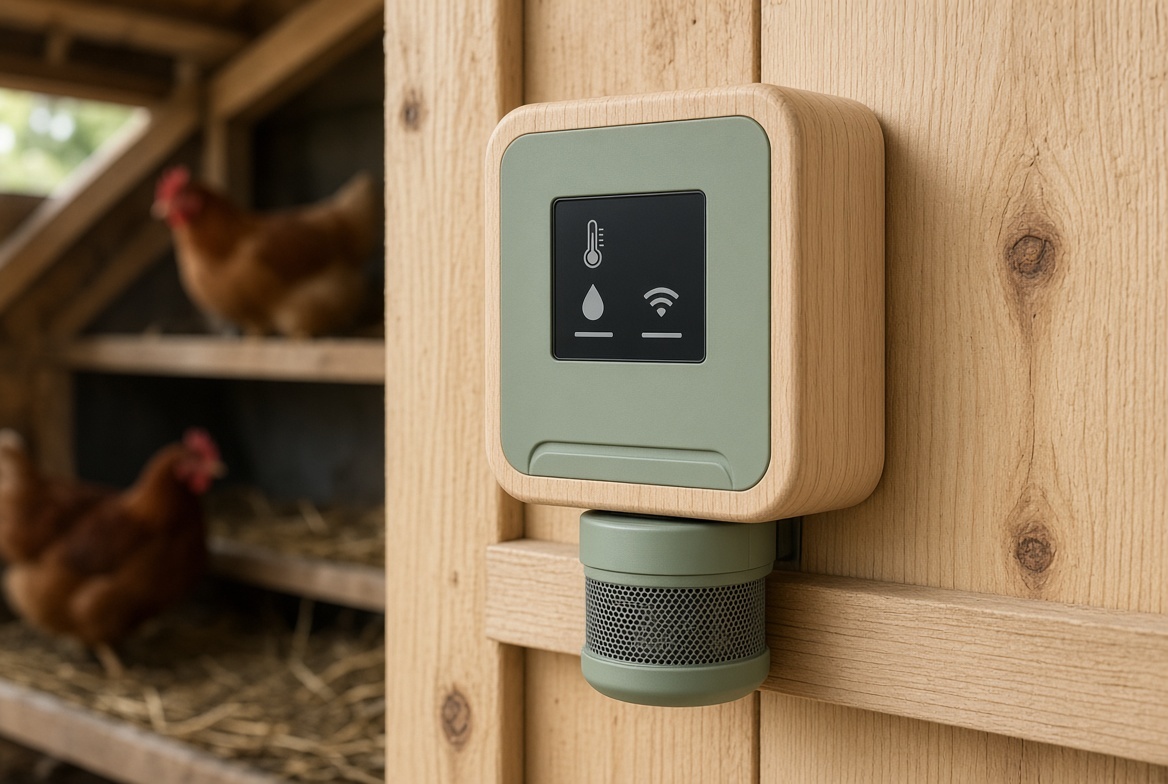
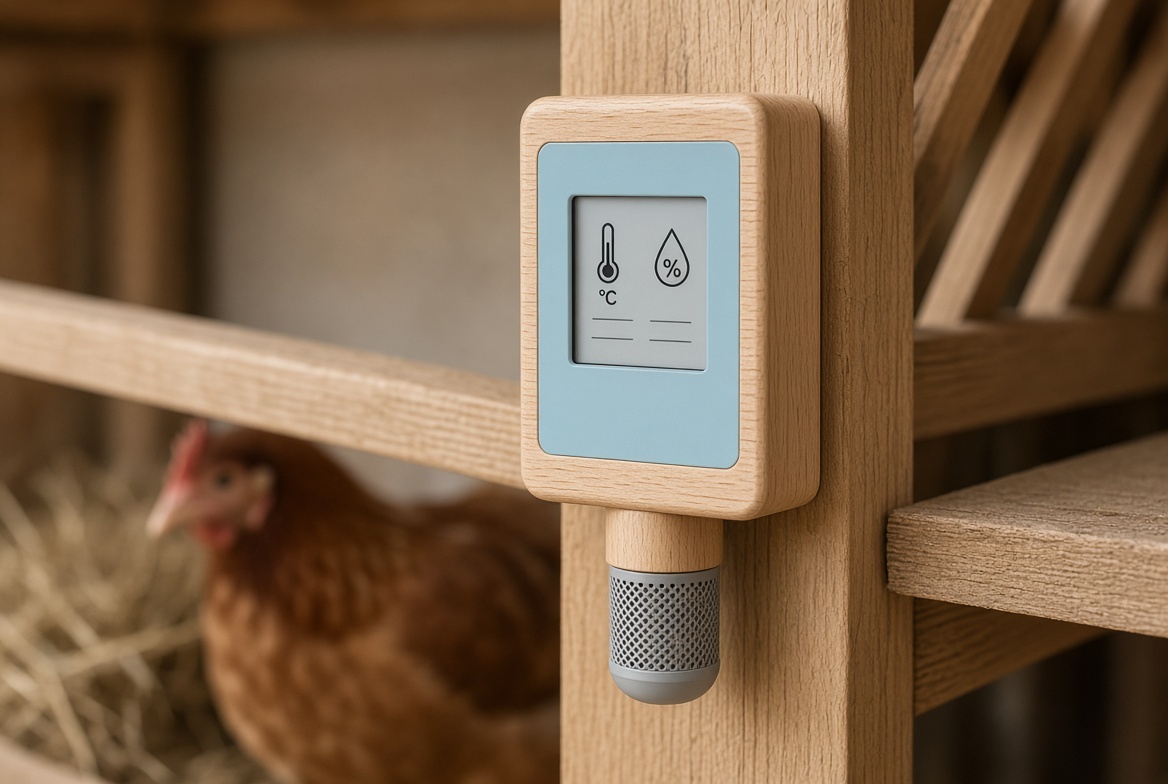
Two versions share the same sensor suite, a wooden enclosure, and a mesh probe fixed to the underside. The Wi-Fi version is sage green, for a coop within range of the house network. The cellular version is duck egg blue, for a remote or outbuilding coop.
Ammonia in a chicken coop
Ammonia is a well-documented air-quality problem in chicken coops, including enclosed or poorly ventilated ones. It affects both commercial houses and backyard flocks. Bacteria produce it when they break down uric acid in droppings, especially in wet litter.
People can usually smell ammonia at about 10–20 ppm. Birds are affected at lower levels. Industry and welfare guidance commonly recommends keeping ammonia below 25 ppm, measured at bird height. Many sources suggest aiming for below 10 ppm where that is possible. In winter, or in a tightly closed coop with damp bedding, levels can rise into the 25–50 ppm range, and sometimes higher in a commercial house.
How ammonia affects the birds
The effect depends on the level and on how long the birds are exposed.
| Level | Effects on chickens |
|---|---|
| About 10–25 ppm | Paralysis of respiratory cilia, greater susceptibility to respiratory disease, and reduced feed efficiency and growth. |
| About 25–50 ppm | Damage to the respiratory tract, eye irritation and conjunctivitis, reduced weight gain, and a higher disease risk. |
| 50 ppm and above | Corneal ulcers, swollen or closed eyes, significant respiratory damage, poor growth, and a higher mortality risk if exposure continues. |
At about 25 ppm, cilia in the trachea begin to be impaired, so birds are less able to clear dust and pathogens. At 50 ppm, cilia can be destroyed, and eye damage, including keratoconjunctivitis, becomes common. Birds may eat less and convert feed less well. Longer exposure is linked with poorer growth, a higher feed conversion ratio, greater susceptibility to disease, and, in layers, lower egg production.
Young birds are particularly vulnerable. So are birds in winter, when ventilation is often reduced to keep the heat in.
The Coop Comfort Sensor measures ammonia at bird height, so a keeper can see when it is rising, including through about 15–25 ppm, and ventilate the coop or change the bedding.
The two versions
| Parameter | Wi-Fi version | Cellular version |
|---|---|---|
| Connectivity | Wi-Fi 2.4 GHz and Bluetooth Low Energy | LTE-M and NB-IoT on a Nordic Semiconductor nRF9151, with GNSS |
| Temperature | Sensirion SHT45, ±0.1 °C | Sensirion SHT45, ±0.1 °C |
| Humidity | Sensirion SHT45, ±1 % RH | Sensirion SHT45, ±1 % RH |
| Ammonia | Electrochemical, 0–100 ppm | Electrochemical, 0–100 ppm |
| CO2 | Optional Sensirion SCD41 NDIR | Optional Sensirion SCD41 NDIR |
| Probe | Bottom-mounted mesh guard | Bottom-mounted mesh guard |
| Display | E-ink status and LED ring | E-ink status and LED ring |
| Power | Li-Po battery, USB-C, optional solar | Li-Po battery, with PSM and eDRX |
| Enclosure | Wood, with an IP-rated electronics bay | Wood, with an IP-rated electronics bay |
| Colour | Pastel sage green | Pastel duck egg blue |
Sensing and placement
The probe is fixed to the underside of the wooden enclosure and covered by a fine mesh guard. That holds the sensors at bird height and clear of heat sources, without a loose cable that can be pecked or snagged. The main unit mounts on a coop wall or beam.
- Temperature and humidity from a Sensirion SHT45
- Factory-calibrated electrochemical ammonia, not a VOC proxy
- Optional true NDIR CO2 from a Sensirion SCD41
- On-device traffic light: green, amber, or red
- A small e-ink window for the current conditions
Alerts
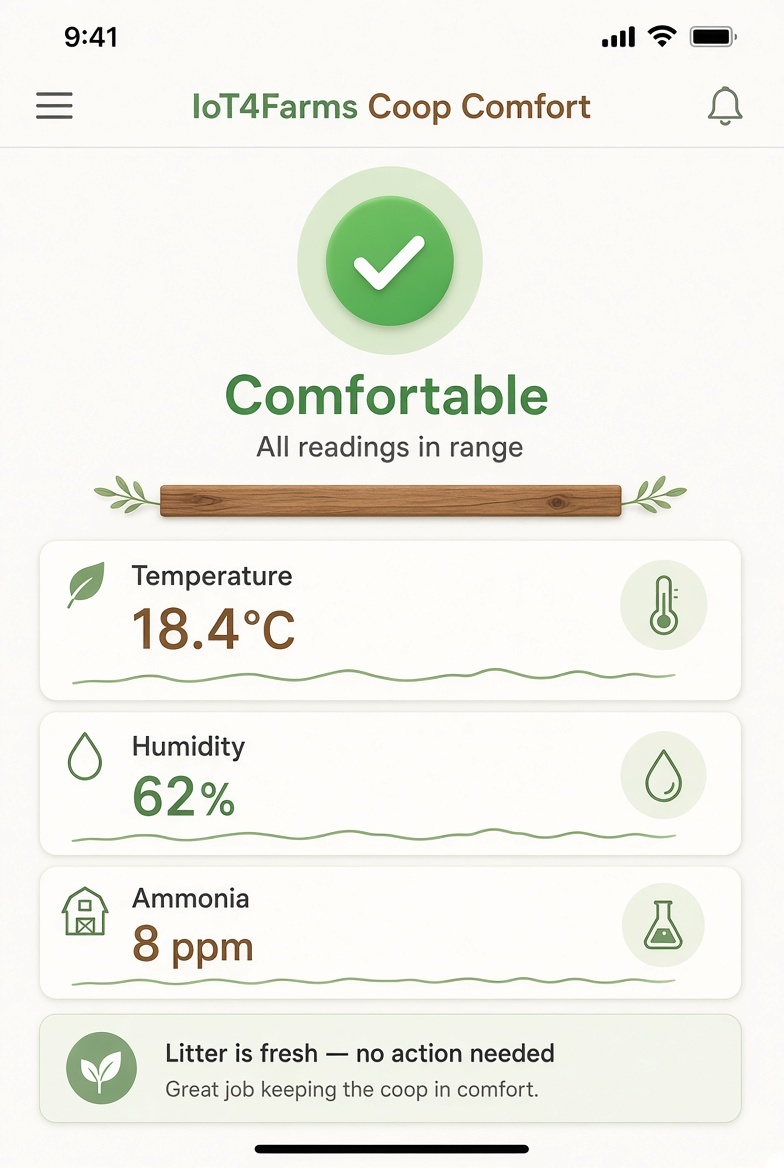
The companion app uses plain language rather than asking the keeper to interpret raw numbers. Thresholds are pre-set for a typical backyard flock and can be adjusted. The app keeps a history and can send a push notification.
- Comfortable — all readings in range
- Ammonia rising — check ventilation or clean litter
- High ammonia — act soon to protect bird health
Next step
Ask about the Coop Comfort Sensor
Tell us whether the coop is on the house Wi-Fi or needs the cellular version.